
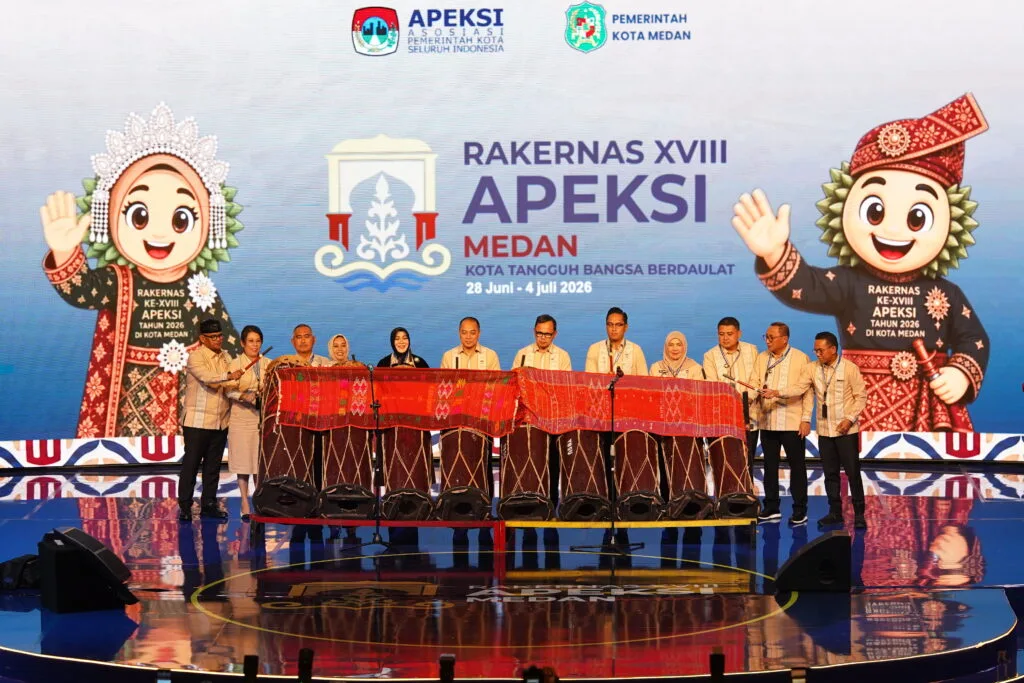
Medan — The 18th National Working Meeting (Rakernas) of APEKSI officially opened in Medan on Wednesday (July 1), marking the start of the highest-level forum for city governments to develop joint steps to address increasingly complex urban development challenges. With the theme “Resilient City, Sovereign Nation,” this year’s Rakernas prioritized collaboration, innovation, and strengthening fiscal capacity as the primary foundations for building adaptive cities amidst economic dynamics, changing national policies, and increasing disaster risks.
The opening of the Rakernas was attended by dozens of mayors from across Indonesia, officials from the central government and provincial governments, as well as various development partners. Over the next few days, participants will participate in various strategic forums discussing urban issues, ranging from food security, digital transformation, development planning, investment, the environment, and youth empowerment.
From Medan, an Invitation to Transform Commitment into Action
Starting the opening ceremony, Medan Mayor Rico Waas expressed his appreciation to all city delegates present in the capital of North Sumatra. He assessed that the enthusiasm of participants who had participated in various pre-Rakernas agendas, including the Youth City Changers (YCC), reflected the strong spirit of collaboration among city governments across Indonesia.
However, he believed that the greatest value of the Rakernas lay not in the numerous forums held, but rather in the implementation of the results of the discussions. All ideas, recommendations, and commitments generated during the Rakernas were expected to be translated into policies and innovations that truly benefit the community.
This enthusiasm was also demonstrated through the launch of Qresto, a digital taxation system developed by the Medan City Government in collaboration with Bank Indonesia and Bank Sumut. Through a split billing mechanism, restaurant tax payments are processed automatically and transparently, allowing regional revenues to be directly deposited into the Regional General Treasury Account without compromising the rights of business owners.
This innovation was introduced as an example of good practice that can serve as a reference for other cities in strengthening local revenue (PAD) through digital transformation.
APEKSI Strengthens Solidarity and Intercity Learning Space
The Chairman of the APEKSI Board of Directors and Mayor of Surabaya, Eri Cahyadi, emphasized that the National Working Meeting (Rakernas) is not simply an annual organizational event, but rather a shared space for city governments to formulate solutions to the various challenges facing the regions.
Amid adjustments to regional transfers, increasing needs for personnel expenditures, waste management, and demands to strengthen local revenue (PAD), city governments are required to continuously adapt without losing their spirit of innovation.
Therefore, APEKSI continues to strengthen its advocacy function with the central government while building an intercity learning ecosystem. Various forums within the Rakernas are designed to provide a space for sharing best practices, ranging from development planning, digital transformation, food security, and local economic development.
He explained that each city has different challenges and characteristics, so not all policies can be implemented with the same approach. In fact, through APEKSI, the success stories from one city can inspire others.
This spirit of sharing, he continued, has been the organization’s main strength. No city feels the most advanced or the most lagging behind, as every member has experiences from which to learn together.
In addition, APEKSI continues to push various strategic agendas, such as strengthening city branding, promoting regional innovation internationally, and advocating for various regulations related to regional governance and central-regional financial relations.
Regional Government Collaboration Doesn’t Stop at the Central Level
North Sumatra Governor Bobby Nasution welcomed the 18th APEKSI National Working Meeting in Medan and expressed his appreciation for APEKSI’s role as a forum for conveying the aspirations of city governments.
According to him, the various recommendations produced by APEKSI have contributed significantly to encouraging the improvement of national policies. However, he also proposed expanding the scope for collaboration by involving provincial governments as part of the solution to various regional problems.
He cited several fiscal issues and regional revenue management that could be discussed jointly between city and provincial governments so that their benefits could be felt more widely by the community.
The North Sumatra Provincial Government also expressed its support for various digital innovations developed by city governments, including the auto-split tax system, which is considered capable of increasing transparency and accountability in regional revenues.
Adaptive Leadership is Key to City Resilience
In his keynote speech entitled “Optimizing Regional Financial Management Amidst Budget Efficiency Policies,” Deputy Minister of Home Affairs Bima Arya Sugiarto urged all regional heads to view challenges as an opportunity to strengthen their leadership qualities.
According to him, regional heads currently face at least four major challenges: global geopolitical dynamics, the implementation of national priority programs, the implementation of regional heads’ visions and missions, and changes in the public communication landscape influenced by social media algorithms.
Amidst shrinking fiscal space, each regional head’s ability to respond to these challenges is crucial. Therefore, increasing local revenue (PAD) cannot be understood solely as a technological issue, but rather as part of regional revenue reform that requires leadership, innovation, and courage to make decisions.
He appreciated the various good practices that have emerged in APEKSI member cities, ranging from payment digitization and public service innovation to strategies for increasing local revenue (PAD) that have proven to produce significant improvements in several regions.
He believes these experiences demonstrate that success is not solely determined by a region’s initial conditions, but also by the quality of leadership and the ability to bring about change.
In addition to fiscal strengthening, Bima Arya also emphasized the importance of building a strong city identity (city branding) as a strategy to increase regional competitiveness. Cities that consistently highlight their character, history, and future aspirations will more easily attract investment, tourists, and other economic opportunities.
He also praised the development of the Youth City Changers (YCC) program, which is considered successful in opening up space for young people to participate in urban development. He stated that young people are not only future leaders but have become part of the current leadership that needs to be involved in designing the city’s future.
Concluding his speech, the Deputy Minister of Home Affairs reminded that development challenges cannot be faced individually. The culture of collaboration, mutual learning, and the spirit of brotherhood that has long characterized APEKSI constitute social capital that must be continuously maintained.
National Working Meeting as a Space for Formulating Joint Solutions
The opening of the 18th APEKSI National Working Meeting demonstrated a common thread among all speakers. City resilience is not only determined by fiscal capacity or technological sophistication, but also by the ability of local governments to build collaboration, strengthen innovation, and learn from each other to face evolving challenges.
Through various forums held during the National Working Meeting, city governments are expected to produce recommendations that not only address issues but also offer solutions based on real-world experiences in the regions. With this spirit of togetherness, APEKSI reaffirms its role as a collaborative hub for city governments to strengthen regional capacity while supporting the realization of more resilient and sustainable national development. (GS)