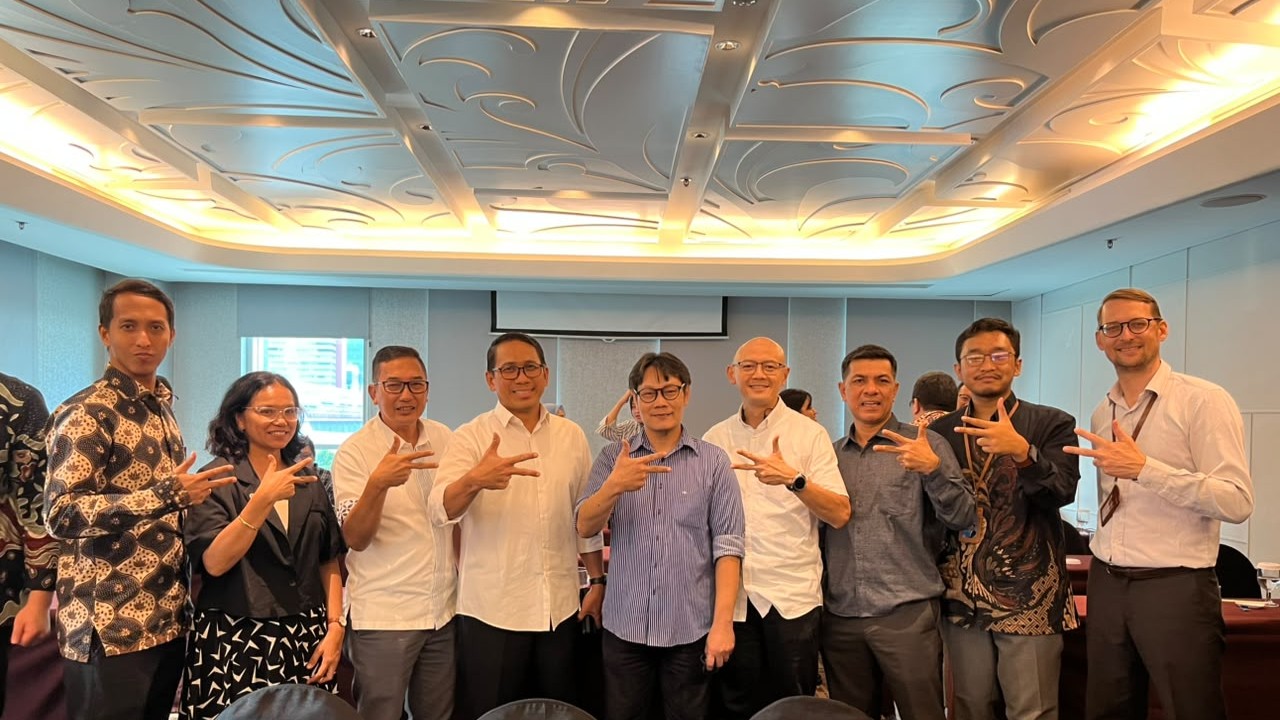
Jakarta — APEKSI urges that the energy transition agenda at the urban level should not be limited to conducting studies and capacity building; rather, it must be realized through implementation tailored to the specific needs and capabilities of local governments. This point was raised during a joint workshop held by the Ministry of Energy and Mineral Resources (ESDM) and GIZ—titled “2026 Evaluation and 2027 Operational Plan”—on November 4, 2026, at the JS Luwansa Hotel and Convention Center, Jakarta.
APEKSI was represented at the event by Teguh and Radite. The workshop brought together ministries/agencies, city governments, financial institutions, and development partners to evaluate the implementation of energy programs throughout 2026, foster synergy, and develop an operational plan for 2027.
This forum is part of a technical cooperation initiative between Indonesia and Germany aimed at supporting a sustainable energy transition and achieving Net Zero Emission targets. Several initiatives were discussed, including the Sustainable Energy Transition in Indonesia (SETI) program, Carbon2Price, and sustainable energy financing.
During the discussion session, Teguh noted that the SETI program is highly relevant to the needs of city governments, particularly in promoting energy efficiency, the utilization of renewable energy, and the development of green buildings.
“From APEKSI’s perspective, we see the SETI activities as highly relevant to the needs of city governments—specifically in fostering energy efficiency, the use of renewable energy, and the development of green buildings,” said Teguh.
Nevertheless, he highlighted the challenges involved in translating the findings from studies and capacity-building efforts into tangible implementation at the local level. According to him, variations in human resource capacity, institutional frameworks, and budgetary capabilities across different cities must be taken into account when developing such programs. Teguh also emphasized the importance of drawing lessons from the implementation of the SETI program in the cities of Batam and Surabaya, so that it can be replicated in other cities by tailoring it to the specific needs of each region.
“We hope that future SETI activities will further encourage the concrete implementation and sustainability of energy transition programs at the municipal government level,” he added.
This input was met with a positive response from GIZ. In its reply, GIZ noted that APEKSI serves as a vital channel for scaling up the lessons learned and best practices from Batam and Surabaya to other cities through coordination, advocacy, and the mainstreaming of the energy transition agenda. GIZ also outlined plans to expand the SETI program to six additional cities beyond Batam and Surabaya, as included in the program proposal.
Beyond program implementation, the link between study findings and local policy is also a priority for APEKSI. Radite highlighted the importance of sharing the final reports from the completed studies, which could then serve as a reference for drafting policies and technical guidelines. During the discussion, GIZ confirmed that the reports have been finalized and will be shared following some last refinements.
Financing and Collaboration Are Key
In addition to implementation and policy aspects, the workshop addressed the importance of project readiness and access to financing to support the energy transition at the local level. Several participants underscored the need to develop a project pipeline, conduct feasibility studies, and utilize innovative financing instruments to ensure that clean energy initiatives can be realized.
Opportunities for collaboration with financing institutions—such as PT Sarana Multi Infrastruktur (PT SMI) and PT Penjaminan Infrastruktur Indonesia (PT PII)—were also discussed. Such support is considered essential for assisting local governments in preparing projects that are both technically and financially viable. Potential urban-level implementations include the deployment of rooftop solar photovoltaic (PV) systems on government buildings, enhancing building energy efficiency, modernizing public street lighting, and integrating renewable energy into public service facilities.
For APEKSI, these initiatives offer an opportunity to strengthen the organization’s role as a bridge—connecting the needs of city governments with support from the central government, development partners, financial institutions, and the private sector.
Moving forward, assessing the needs and readiness of member cities can serve as an initial step toward expanding the implementation of energy transition programs. By taking into account the unique characteristics of each region, successful practices from pilot cities can be developed into broader, more sustainable models.
Radite Ranggi Ananta
APEKSInternship #9