
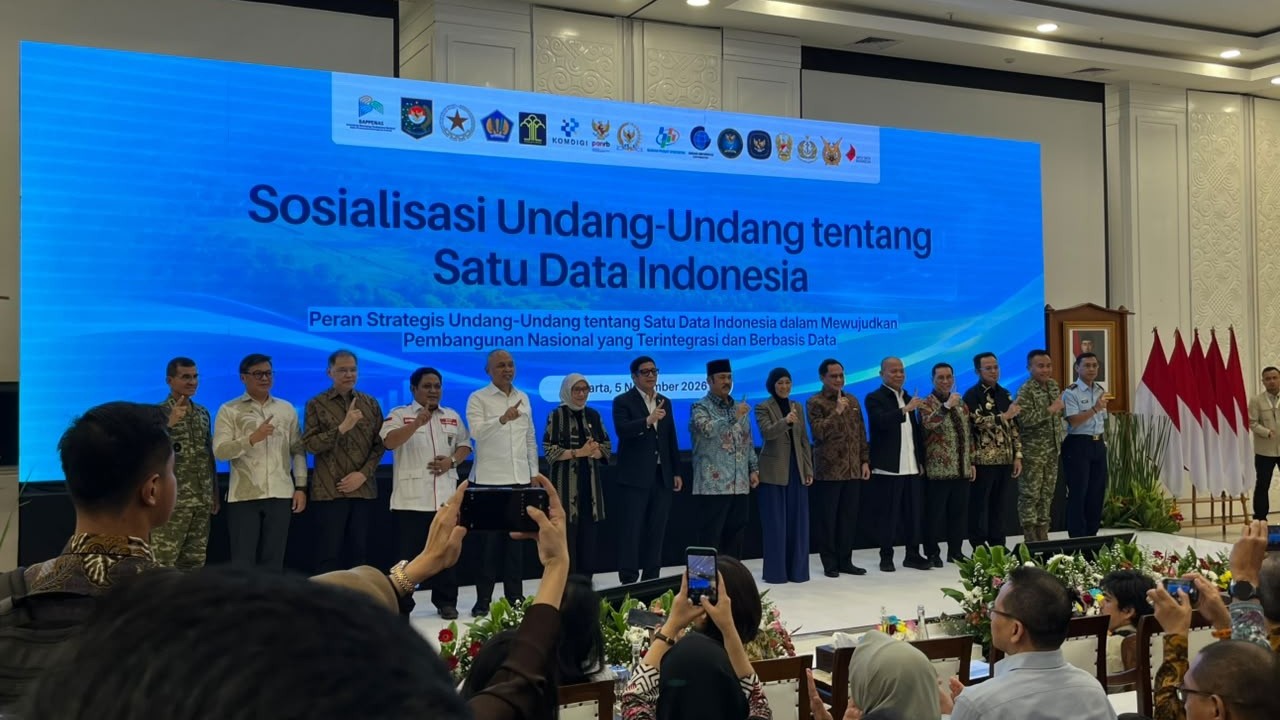
APEKSI attended a socialization event regarding the “One Data Indonesia” (SDI) Law, hosted by the Ministry of National Development Planning/Bappenas on Thursday, November 5, 2026. During the forum, government officials explained that the SDI Law serves as a legal framework to strengthen national data governance through standardization, integration, interoperability, and rigorous data protection. This strategic policy is designed to address the issue of fragmented data—currently scattered across various agencies—while fostering more accurate development planning and enabling integrated public services, ensuring that citizens no longer need to repeatedly provide the same information.
In the panel discussion session, the Directorate General of Population and Civil Registration (Ditjen Dukcapil) of the Ministry of Home Affairs highlighted the critical role of the National Identity Number (NIK) and the Digital Population Identity (IKD) as the foundation for integrating public services—ranging from the distribution of social protection to the issuance of birth certificates. From an academic perspective, Prof. Dr. Ir. Suhono Harso Supangkat, M.Eng., emphasized the immense potential of leveraging integrated data combined with artificial intelligence (AI) to enhance service precision, while also noting the challenges posed by disparities in digital infrastructure across different regions. Furthermore, the forum explored technical and regulatory aspects, including the alignment of data standards, system interoperability, authority for data exchange, metadata quality, and the assurance of policy and budgetary support.
Ultimately, the successful implementation of the SDI Law hinges on the readiness of local governments—particularly city governments—to strengthen data governance across regional agencies, enhance human resource capacity, and improve digital infrastructure and budgetary support. Solid synergy between the central and regional governments is the key to ensuring that this data integration policy does not merely serve as a regulatory formality, but truly succeeds in accelerating precise development planning and delivering more effective, well-targeted public services at the local level.