
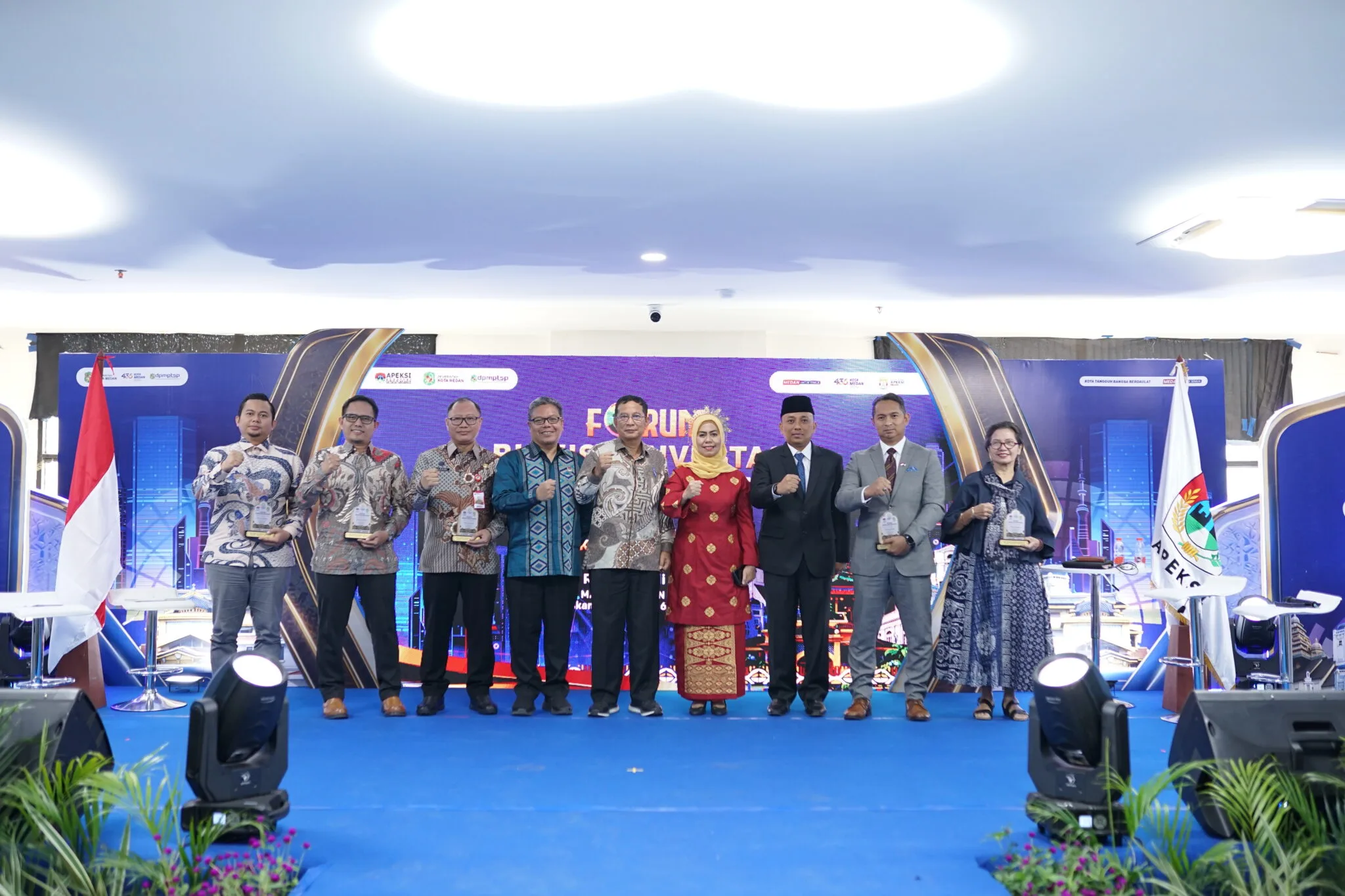
Medan – Increasing regional investment value is a key pillar in accelerating city development. To address this strategic challenge, APEKSI (Indonesian Association of Indonesian Investment and One-Stop Integrated Services) and the Medan City Government held a Business and Investment Forum, attended by the Heads and representatives of the Investment and One-Stop Integrated Services Offices (DPMPTSP) from various cities across Indonesia. On the first day, the Forum was held at the Medan City Public Service Mall.
With the overarching theme “Realizing a Resilient and Sovereign City through Quality Investment,” the Business and Investment Forum, part of the APEKSI 18th National Working Meeting (Rakernas), facilitated agency leaders to formulate tactical steps to optimize their regions’ potential to attract investors.
The forum was comprehensively structured into two main sessions. In the first session, participants’ insights were enriched through a talk show featuring cross-sectoral discourse. From a macroeconomic perspective, the Executive Director of CORE Indonesia, Muhammad Faisal, Ph.D., outlined strategies for repositioning cities within the global supply chain and the importance of downstream investment. This presentation was complemented by a representative from the Ministry of Tourism, Rendi Rusgian, who explored investment opportunities in the increasingly promising tourism sector.
The forum, focusing not only on theory, also emphasized real-life case studies. The Head of the Surabaya City DPMPTSP, Ir. Lasidi, S.T., M.T., was present to share best practices that have been successfully implemented in his region. Furthermore, the international collaboration dimension was presented through a presentation by the Malaysian Consul General in Medan, Shahril Nizam Abdul Malek, regarding cross-border market opportunities, as well as strategic direction from the Deputy Secretary General of CITYNET, Dr. Ir. Aisa Tobing, MSc., regarding strengthening global urban planning networks.
Entering the second session, the agenda transformed into an interactive discussion space to formulate policy recommendations. This reflective session provided a forum for DPMPTSP staff to analyze real-world challenges frequently encountered in the field. Several crucial issues that emerged included the urgency of improving human resource (HR) capacity, particularly foreign language skills, for negotiating with global investors. On the other hand, bureaucratic obstacles are still considered to limit some regions’ proactive movement, including the need to adapt digital technology-based services.
Overall, the Business and Investment Forum was appreciated by participants. The presence of speakers with diverse backgrounds, ranging from economists and bureaucrats to international practitioners, was deemed successful in addressing the agency’s essential needs. Through a more comprehensive understanding, the DPMPTSP is expected to continue transforming into a vanguard agency that not only excels in licensing services but also reliably promotes city economic resilience in the eyes of the world.
Article by:
Roidah A. Showfah
APEKSInternship Batch 8