
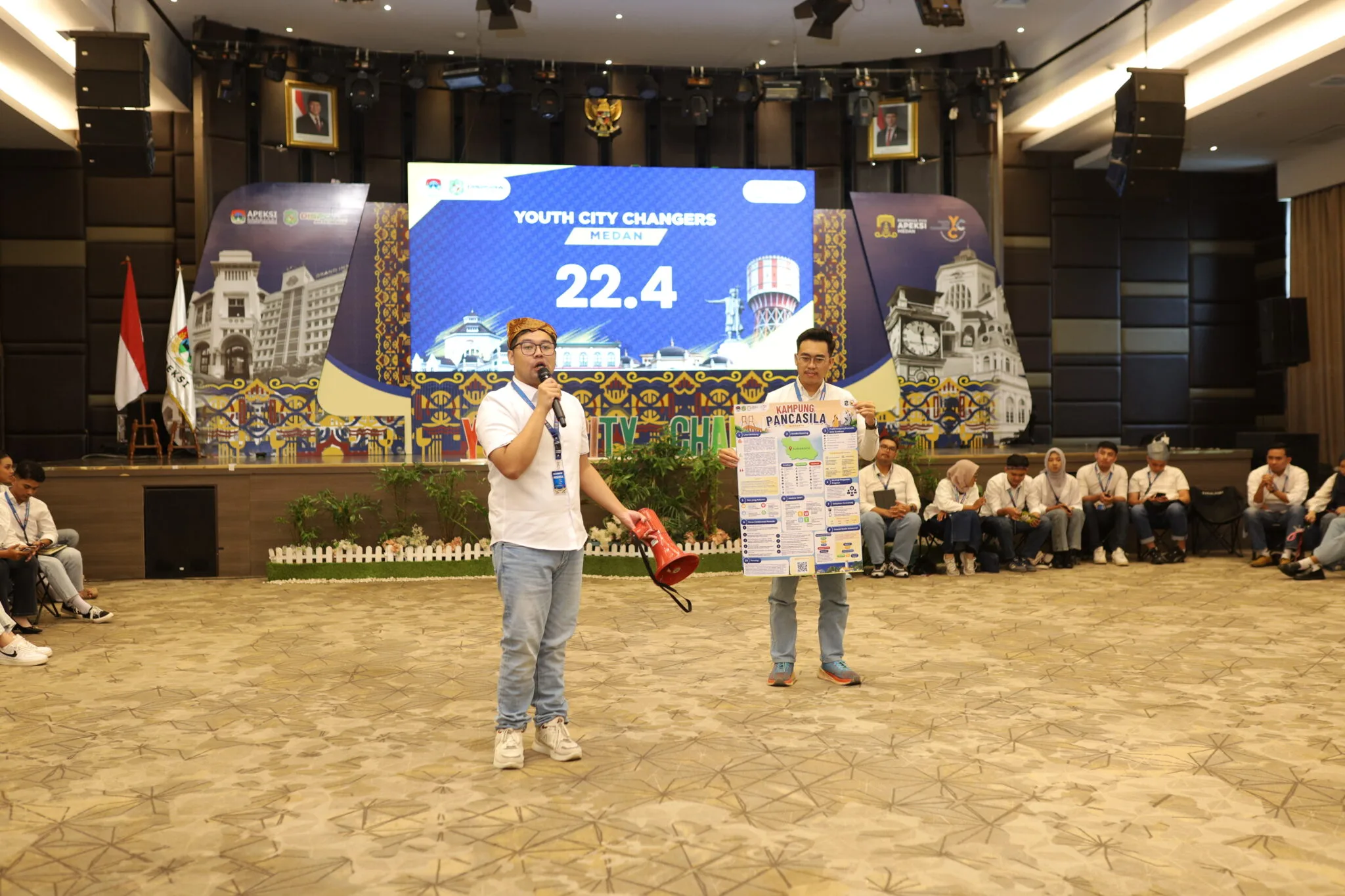
Medan – The energy and enthusiasm of the Youth City Changers (YCC) 2026 delegates were increasingly evident on the second day, Monday (June 29, 2026). Held at the Le Polonia Hotel, the YCC series of events encouraged the creativity of the youth representatives from various cities in attendance.
The day’s excitement kicked off with the “Kombur” session, a local Medan term meaning “chat”—which served as a dynamic forum for exchanging ideas. In the Kombur 1 session, each city representative was challenged to present their city resilience challenges and innovations within 90 seconds. Interestingly, many of them brought props such as posters, artwork, and even uniquely designed clothing representing the innovations of their hometowns.
The atmosphere became more fluid and interactive as participants moved on to the bridging games session. In this session, all delegates were divided into six groups and given the ambitious mission of building an imaginary city. They were provided with only a map with varying topography, complete props, and a fictitious budget, each team receiving varying amounts.
This simulation truly put the participants’ collaboration and negotiation skills to the test. They had to think creatively to design a city that was not only livable but also resilient to various scenarios. The excitement peaked at the end of the game when the results of each group’s hard work were measured through the distribution of stars and tax calculations recorded on their city report cards.
Afterward, each group received two more challenge cards. These cards ranged from natural disasters and biological disasters to social disasters and budget cuts. In this session, each group had to re-strategize and determine priority sectors according to the conditions of the area on the map provided.
After completing their role-playing and designing their city on paper, participants were encouraged to think more reflectively in the Kombur 2 session. They were asked to review the conditions of their home city: Is our city truly resilient?
This session opened the eyes of many to the fact that the definition of a “resilient city” is actually quite broad. Resilience is not only measured during natural disasters but also encompasses economic resilience, human resource (HR) readiness, and food security. A city can only be considered resilient if it is able to map problems, plan solutions, execute, and monitor all of these sectors.
From the knowledge exchange at Kombur 1 and 2, the YCC delegates finally realized an important common thread. The problems faced by one city are often similar to those experienced by another. This similarity gave rise to many valuable lessons learned, reminding them that great innovation must be supported by strong collaboration. Cross-regional collaboration is key to realizing sustainable development transformation in the future.
Article by:
Roidah A. Shofwah
APEKSInternship Batch 8