
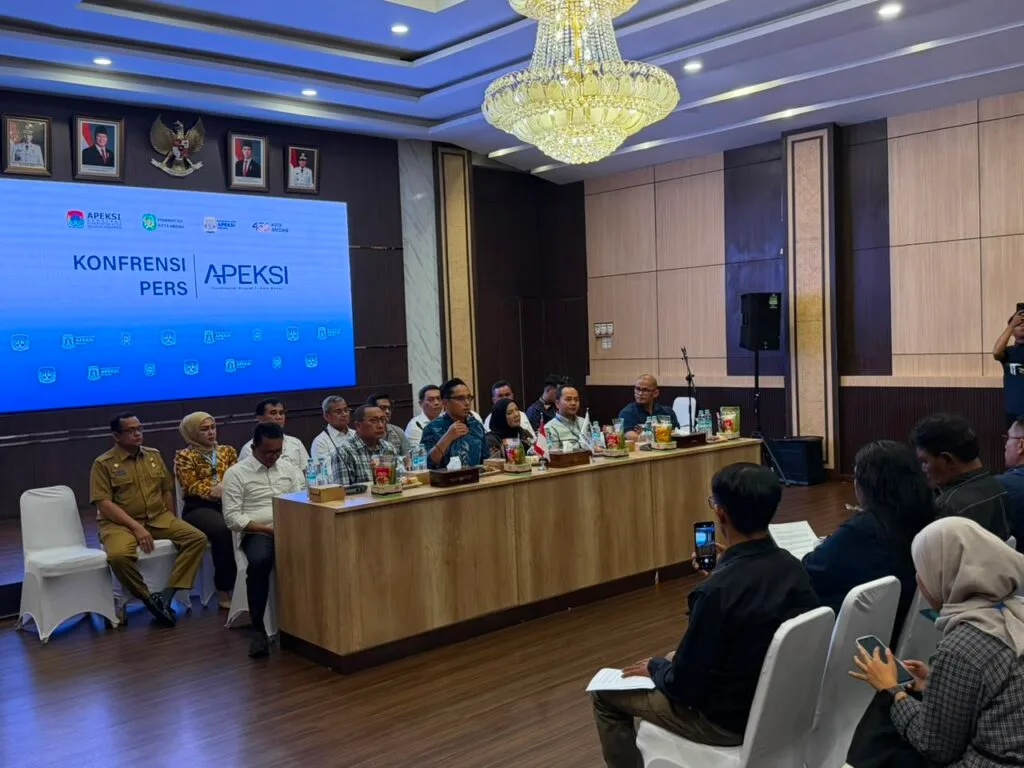
Medan – The Association of Indonesia Municipalities (APEKSI), along with the Medan City Government, has confirmed that all preparations for the 18th APEKSI National Working Meeting (Rakernas) are complete. Themed “Resilient City, Sovereign Nation,” the Rakernas will serve as a strategic forum for mayors to strengthen collaboration, formulate policy recommendations, and share best practices in addressing various urban development challenges.
This was conveyed at a press conference attended by Medan Mayor Rico Tri Putra Bayu Waas, APEKSI Executive Director Alwis, Surakarta Mayor Respati Ardi, Bandar Lampung Mayor Eva Dwiana, and Ternate Mayor M. Tauhid Soleman.
Medan Mayor Rico Tri Putra Bayu Waas explained that the Rakernas series began on June 28th with the Youth City Changers (YCC) program, which involves young people as partners in city development. The mayors’ arrival is scheduled for June 30th, and they will be welcomed at Medan’s Merdeka Square, coinciding with the closing ceremony of the GEMES event, which aims to introduce Malay culture to all participants.
The mayors also attended the Medan City Anniversary Ceremony, followed by a series of Working Meeting activities, including the Mayor’s Talk and a keynote speech by the Deputy Coordinating Minister for Food, Hanif Faisol Nurofiq. The opening of the Indonesia City Expo (ICE) also took place on the first day. Sixty cities participated in ICE, showcasing superior products from regional MSMEs. In addition, the public was able to visit the MSME and culinary bazaar at Benteng Field, as well as exhibitions from the Regional Disaster Management Agency (BPBD) and the Fire Department.
According to Rico, the theme “Resilient City, Sovereign Nation” was chosen in response to the various challenges facing Indonesian cities, from natural disasters and fiscal pressures to climate change.
“A resilient city is one that can survive in various situations. It not only has good disaster mitigation, but is also fiscally resilient, able to control inflation, protect the environment, and have a recovery strategy in the face of crises,” he said.
In addition to the National Working Meeting (Rakernas), the event also features a Ladies Program, a city tour of Medan’s cultural district, a visit to the Public Service Mall and the Dekranasda Gallery, and various thematic forums bringing together regional officials from across Indonesia.
On the second day, all mayors are scheduled to participate in joint sports activities, plant trees, and inaugurate the Resilient City Monument in Cadika Park as a symbol of their shared commitment to building more resilient and sustainable cities. This will be followed by a series of plenary sessions of the National Working Meeting. The National Working Meeting will be closed by the Coordinating Minister for Infrastructure and Regional Development, Agus Harimurti Yudhoyono. That evening, a Cultural Carnival will be held, involving approximately 70 cities.
A total of 88 mayors, four deputy mayors, two regional secretaries, and one head of the Regional Development Planning Agency (Bappeda) are confirmed to attend the 18th APEKSI National Working Meeting, representing the 98 APEKSI member cities. The cultural carnival is expected to attract approximately 2,800 participants, while the Indonesia City Expo and bazaar will feature 375 MSMEs. The Medan City Government estimates that the National Working Meeting (Rakernas) will boost economic turnover by around IDR 72 billion.
APEKSI Executive Director Alwis emphasized that the Rakernas is not merely a ceremonial event, but rather a strategic forum to strengthen the city government’s position in facing development challenges.
He stated that amidst regional fiscal constraints, geopolitical dynamics, and national economic conditions, regional heads need a space to exchange experiences and develop joint solutions. The results of the Rakernas will be formulated into various policy recommendations that will be submitted to the central government through official letters and audiences.
“Cities are the parties closest to the people. Therefore, APEKSI’s recommendations are based on the city government’s real-world experience in providing public services, not solely from an administrative approach,” he said.
Surakarta Mayor Respati Ardi added that cities are benchmarks for national progress. Through the Rakernas, mayors will convey various recommendations to ensure that national policies increasingly address regional needs.
Meanwhile, Bandar Lampung Mayor Eva Dwiana highlighted the importance of strengthening coordination between local and central governments in flood management, particularly regarding river management, which falls under the authority of the city hall. According to her, flooding is a major challenge faced by many cities and requires synergy across government agencies.
Meanwhile, Ternate Mayor Tauhid Soleman viewed the National Working Meeting as an important platform for cities to learn from each other. He commended Medan City’s various innovations, including the digitalization of the Qresto tax service, which he believes has the potential to increase regional revenue. He also urged greater attention to waste management in coastal and island areas in the National Working Meeting’s recommendations.
In addition to the main session, the 18th APEKSI National Working Meeting also featured several thematic forums, including the Food Forum, the Regional Development Planning Agency (Bappeda) Forum, the Environment Forum, the Business Forum, and the Communication and Digital Forum. Through these forums, city governments are expected to develop concrete solutions to various urban issues while strengthening interregional collaboration.
The 18th APEKSI National Working Meeting in Medan is expected to produce policy recommendations that can strengthen city resilience in various sectors, from fiscal policy and public services to climate change and digital transformation, to regional economic development. The underlying spirit is that no city can develop alone; the progress of Indonesian cities is the foundation for the nation’s progress. (GS)