
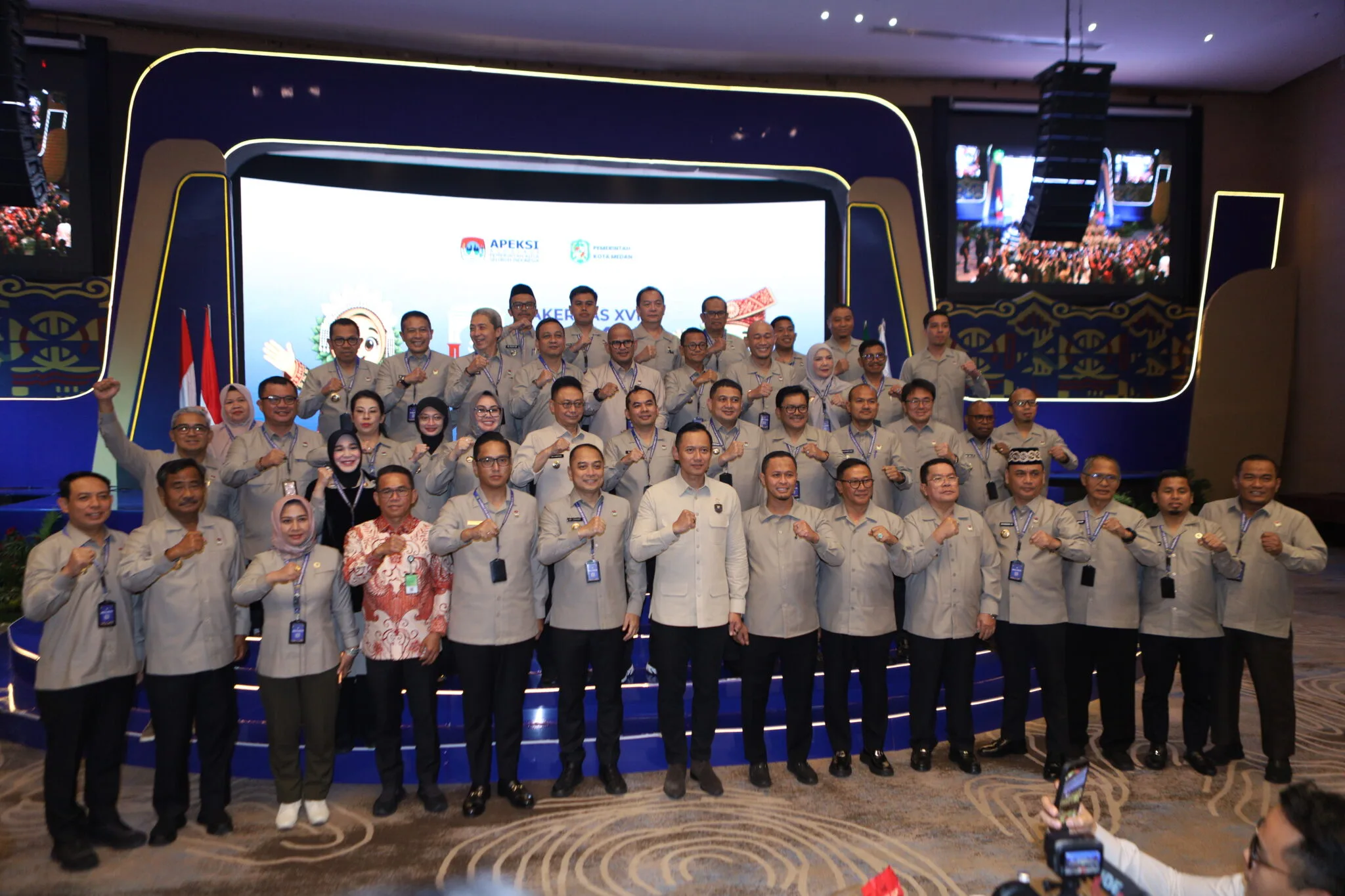
Medan — The 18th APEKSI National Working Meeting (Rakernas) officially concluded in Medan on Thursday (July 2). However, the conclusion of this forum did not mark the end of the series of city government meetings, but rather the beginning of a shared commitment to translate various recommendations into concrete policies and actions in their respective regions.
Since its inception through Youth City Changers (YCC), various thematic forums, inter-city discussions, and organizational meetings, the 18th APEKSI Rakernas has served as a platform for mayors to exchange experiences and develop a shared agenda to address urban development challenges. Various issues emerged, ranging from strengthening regional fiscal capacity, food security, digital transformation, environmental management, investment, disaster mitigation, and strengthening governance.
All these discussions ultimately led to a common goal: strengthening city capacity to become more resilient in the face of change and to become drivers of national development.
The National Working Meeting May End, But Collaboration Doesn’t
In his closing remarks, Medan Mayor Rico Tri Putra Bayu Waas expressed his appreciation to all mayors, delegates, APEKSI administrators, the committee, the Medan City Government, and the workers and creative industry players who had made the 18th APEKSI National Working Meeting a success.
He stated that the presence of city governments from across Indonesia was a source of pride for Medan, especially since the National Working Meeting coincided with Medan’s anniversary.
More importantly, the various forums held over the past few days successfully gathered aspirations, experiences, and recommendations from city governments on various issues facing the region. From public services, food security, disaster mitigation, digital transformation, to various other strategic issues, all of which are expected to provide valuable insights to strengthen city development in the future.
City Voices Become Part of the National Solution
For APEKSI, this year’s National Working Meeting not only produced organizational recommendations but also strengthened the city government’s position as a strategic partner of the central government.
The Chairman of the APEKSI Board of Directors, Eri Cahyadi, emphasized that the various recommendations compiled were not intended as a list of regional complaints. Rather, all input represents the city government’s responsibility to ensure that various national strategic programs can be implemented more effectively on the ground.
According to him, the city government fully supports various national policies. However, as the party that deals directly with the community, the city government also has important field experience to inform policy refinements.
Therefore, the various recommendations generated by the National Working Meeting will be submitted to the President and relevant ministries as input accompanied by solutions, not simply criticism.
The same spirit was also reflected in the various good practices shared during the National Working Meeting. Amid adjustments to regional transfers, city governments continue to learn from each other about strategies for increasing Regional Original Revenue (PAD), digitizing services, and innovating governance. For APEKSI, the ability of cities to share experiences is a key asset in facing increasingly complex development challenges.
On the same occasion, Eri Cahyadi also announced that Bandung City will host the next APEKSI National Working Meeting, marking a continuation of collaboration from one city to another.
The Common Thread of the 18th APEKSI National Working Meeting
In conclusion, the entire series of the 18th APEKSI National Working Meeting demonstrated that city governments face increasingly diverse challenges, but share a common need: space for collaboration.
Strengthening regional fiscal capacity was one of the most discussed issues, along with adjustments to regional transfer policies and the increasing need for public service funding. At the same time, cities were also encouraged to accelerate digital transformation, strengthen food security, increase preparedness for disasters and climate change, improve governance, and expand public participation, including for the younger generation.
Through thematic forums, city governments not only shared challenges but also exchanged good practices that have proven successful in various regions. This spirit is APEKSI’s main strength: using the experiences of one city as a learning experience for others.
City Resilience a Shared Agenda
Closing the National Working Meeting (Rakernas), Coordinating Minister for Infrastructure and Regional Development Agus Harimurti Yudhoyono expressed his appreciation for the various ideas emerging from the APEKSI forum and stated the government’s readiness to consider the recommendations within his ministry’s coordination framework.
In his keynote address, titled “Building Resilient Cities, the Foundation of a Sovereign Nation,” AHY emphasized that city development needs to be directed at a balance between economic growth, equity, and sustainability.
According to him, infrastructure development must be understood as an instrument for improving the quality of life for the community, strengthening interregional connectivity, supporting food and energy security, and accelerating inclusive economic growth.
AHY also emphasized that urbanization, climate change, spatial planning issues, congestion, waste management, and increasing public expectations are challenges facing almost all cities in Indonesia. Therefore, future cities need to be built on a foundation of infrastructure resilience, food security, social resilience, economic resilience, and environmental resilience.
This perspective reinforces various issues raised throughout the National Working Meeting, while emphasizing that city development requires close synergy between the central and regional governments.
Continuing the Spirit from Medan
The 18th APEKSI National Working Meeting has officially concluded. However, this forum left behind more than just a series of sessions, discussions, and recommendations.
The National Working Meeting demonstrated that city governments have the ability to learn from each other, share innovations, and develop joint solutions to the various challenges facing the regions. Amidst policy dynamics and fiscal constraints, the spirit of collaboration between cities remains a key force in maintaining the quality of public services and accelerating development.
From Medan, city governments brought home more than just recommendation documents. They brought networks, experience, good practices, and a commitment to continue working together.
Because ultimately, as the spirit espoused throughout the 18th APEKSI National Working Meeting, a resilient city is not built by a single region. It grows when cities strengthen each other, learn from each other, and work together to realize a sovereign nation. (DM/GS)