
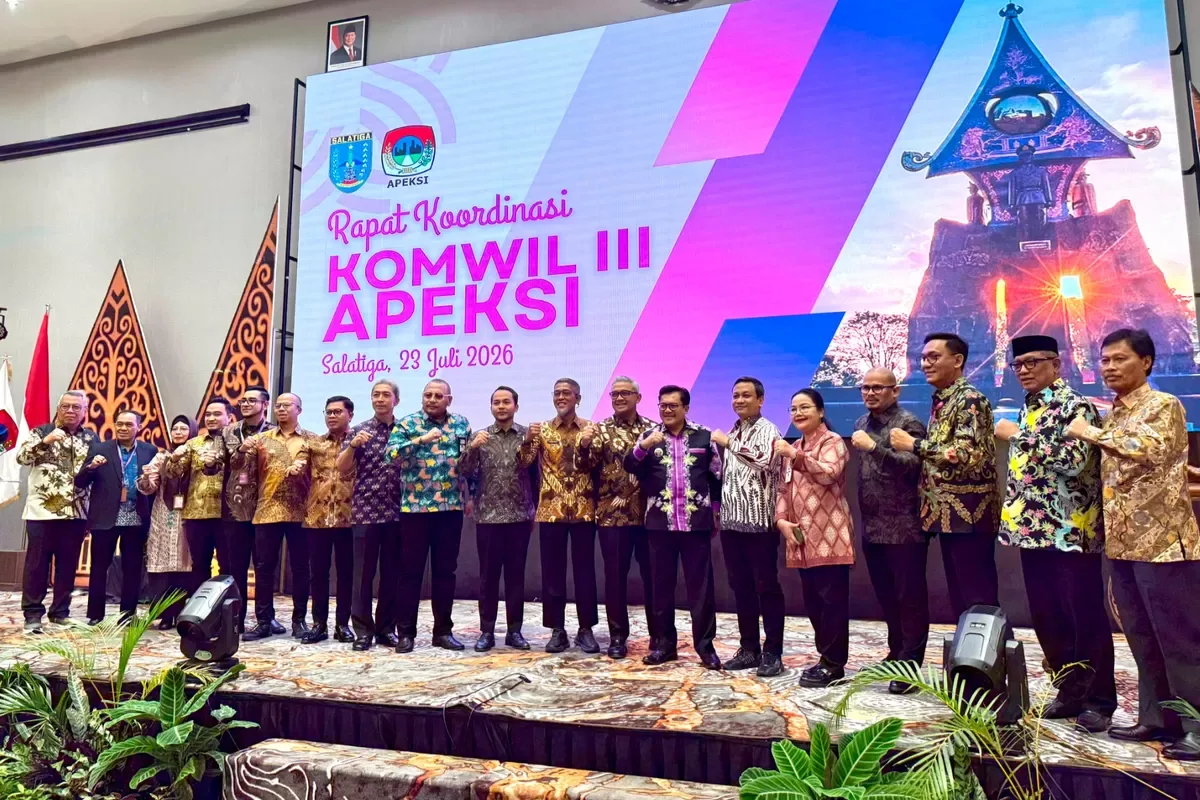
Salatiga — City governments, members of Commissariat Regional III of APEKSI, have united their commitment to strengthening collaboration and synergy in addressing various urban development challenges. This commitment was highlighted at the 2026 APEKSI Commissariat Regional III Working Meeting (Rakerwil III) held on July 22-24, 2025, in Salatiga City, with the theme “From Cities to Indonesia” and the spirit of “Resilient Cities, Sovereign Nations.” The forum, attended by regional heads from 25 APEKSI member cities, served as a follow-up to the 18th APEKSI National Working Meeting in Medan and reinforced the shared agenda of enhancing local government capacity and addressing urban development challenges.
On this occasion, the results of the 2026 APEKSI National Working Meeting in Medan, consisting of 10 general and thematic recommendations from the forums, for ministries and institutions, were presented by the Secretary of the APEKSI Board/Executive Director, Alwis Rustam, and the Mayor of Salatiga, Dr. Robby Hernawan, Sp.OG., who urged all city governments to maintain solidarity and strengthen collaboration in addressing fiscal and urban development challenges. According to him, the jointly agreed-upon recommendations need to be immediately translated into concrete programs and steps that provide tangible benefits to the community. “The mutually agreed-upon recommendations must be immediately translated into concrete steps. We need to unite our efforts so that every policy and program implemented truly provides benefits that are directly felt by the community,” said Robby. He also emphasized the importance of a shared vision among city governments so that regions can become more adaptive, resilient, advanced, and sustainable in facing the dynamics of development.
Several strategic issues were also discussed at the APEKSI Regional Working Meeting III, including strengthening regional fiscal capacity, governance reform, strengthening the civil service, accelerating infrastructure development, digital transformation, resilience to climate change, and increasing the role of the younger generation in development. The Regional Secretary of Central Java Province, Sumarno, S.E., M.M., highlighted the challenges of central and regional fiscal relations, including the structure of regional tax revenues, which are still heavily reliant on the consumption sector, the burden of mandatory spending, and the financing needs for regional elections. “If cities progress, Indonesia will also progress. Cities are the epicenter and driving force for efficient regional progress,” Sumarno stated.
Meanwhile, Muhammad Farhan, Head of Regional Committee III of APEKSI and Mayor of Bandung, presented several strategic recommendations resulting from the 2026 APEKSI XVIII National Working Meeting, including strengthening fiscal capacity, structuring civil servants (ASN) and community-based employee (PPPK), accelerating infrastructure development, digital transformation, and engaging the younger generation. Bogor Mayor Dedie A. Rachim also emphasized the importance of strengthening the role of civil servants (ASN) and regional fiscal policies through synergy between local and central governments. “How can ASN, as a strong pillar of urban development from a bureaucratic perspective, also play a full role in urban development? Of course, how can fiscal policies in each region be strengthened through various commitments from local governments and collaborative synergy with the central government, so that development can be felt to the maximum extent possible by the community?” he said.
The Regional Working Meeting III will further focus on strengthening Regional Committee III’s work program through four main pillars: Climate and Urban Resilience, Governance and Fiscal Reform, Capacity Building, and Youth and Innovation. These four pillars are expected to serve as a foundation for intercity collaboration in responding to urban challenges and encouraging the development of policies and innovations that can be replicated across regions. From Salatiga, Regional Committee III of APEKSI reiterated the importance of a spirit of togetherness among city governments to build resilient and competitive cities, while also making a real contribution to the realization of an advanced, sovereign, and sustainable Indonesia.