
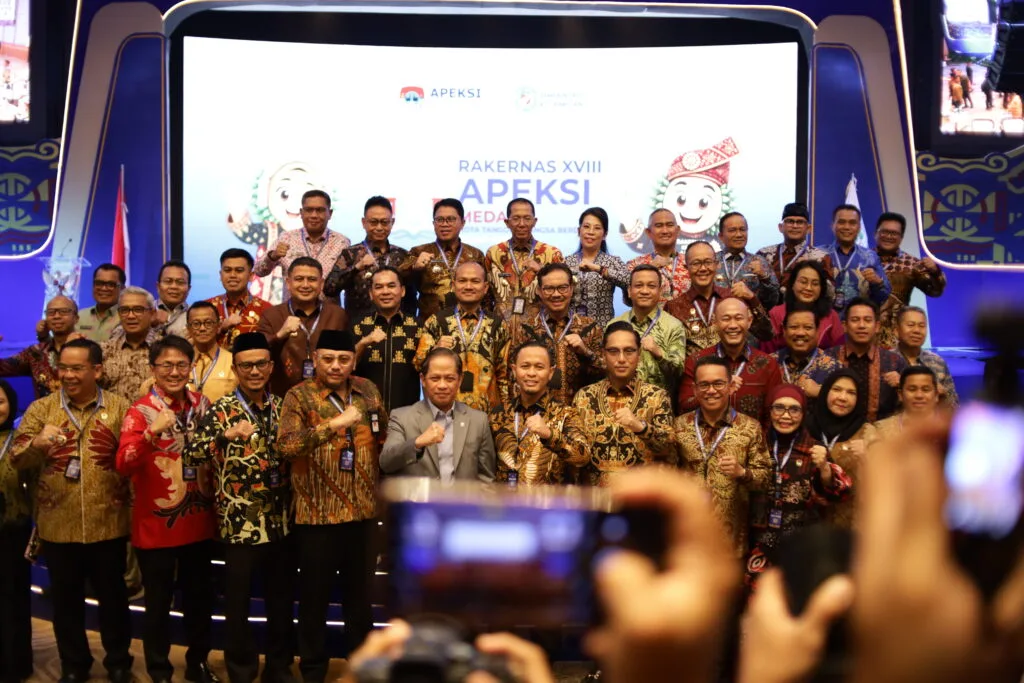
Medan – Building a resilient city is not just about infrastructure development; it also requires strong systems, interregional collaboration, and policies that adapt to community needs. This spirit emerged during the Mayors’ Talk and Resilient City Dialogue, one of the main agenda items of the 18th APEKSI National Working Meeting (Rakernas) in Medan.
Opening the dialogue, Medan Mayor Rico Tri Putra Bayu Waas explained that the theme “Resilient City, Sovereign Nation” was born from Medan’s experience in dealing with major flooding that hit 19 of its 21 sub-districts and affected approximately 85,000 residents. He stated that a resilient city is not only able to respond to disasters but also has a strong prevention system, food and fiscal security, and the ability to recover quickly after a disaster.
Giving remarks, the Coordinating Minister for Human Development and Culture, Pratikno, emphasized that the increasing rate of urbanization presents new challenges for Indonesian cities. With approximately 70 percent of Indonesia’s population projected to live in urban areas by 2045, city governments are expected to be at the forefront of building healthy, safe, inclusive, and human-development-oriented cities. He also urged all city governments to support the Safe and Comfortable Spaces for Children Movement (GERNAS RANA) as a joint effort to protect vulnerable groups in the family room, schools, public spaces, and digital spaces.
Meanwhile, Deputy Coordinating Minister for Food Affairs, Hanif Faisol Nurofiq, in a keynote speech titled “Strengthening Food Systems and Urban Waste Management as the Foundation of Resilient Cities,” emphasized that food security and waste management must be part of the city’s development system. He encouraged city governments to build food systems based on accurate data, strengthen interregional cooperation, maintain food price stability, reduce food waste, and develop collaborative financing to strengthen national food security.
The discussion during the Mayors’ Talk then expanded on various strategic issues facing city governments. The mayors expressed their aspirations regarding strengthening regional autonomy, more adaptive management of civil servants (ASN), fiscal justice through evaluation of Regional Transfers (TKD) and Revenue Sharing Funds (DBH), and the importance of synchronizing central government policies with real regional needs. These inputs will form part of the recommendations for the 18th APEKSI National Working Meeting (Rakernas) to the central government.
In response to these aspirations, APEKSI Executive Director Alwis Rustam emphasized that current challenges facing city governments are no longer solely technical, but also require strengthened dialogue and political will so that regional recommendations can be implemented into more responsive policies. He encouraged all city governments to refine the Rakernas recommendations as part of APEKSI’s joint advocacy.
Through Mayors Talk: Resilient City Dialogue, APEKSI’s 18th Rakernas is expected to not only serve as a forum for sharing experiences between cities but also produce recommendations that strengthen central and regional collaboration and support the realization of increasingly resilient, adaptive, and sustainable cities. (GS)