
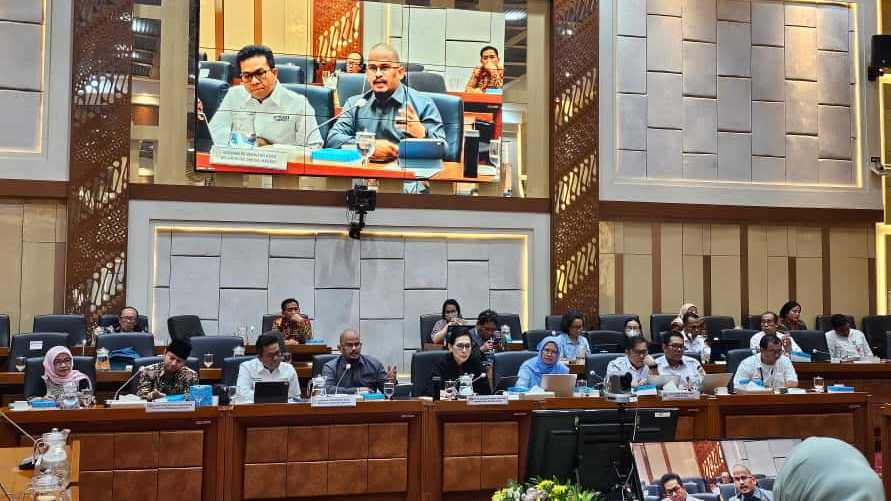
APEKSI presented several crucial issues and strategic recommendations at the Working Committee Meeting of Commission IX of the Indonesian House of Representatives (DPR RI) on 12 November 2025, regarding the oversight of accelerating the elimination of Tuberculosis (TB). Although Indonesia has Presidential Regulation Number 67 of 2021 concerning Tuberculosis Control, its implementation at the regional level still faces serious challenges. The main issues highlighted were weak cross-sectoral coordination—where not all Regional Apparatus Organizations (OPDs) and stakeholders understand and are actively involved in the TB program—and limited budgets and resources. Regional governments remain highly dependent on central government funding and have unequal access to trained health workers and diagnostic facilities, resulting in suboptimal active case finding. Furthermore, the lack of a real-time and integrated reporting system, along with the high rate of treatment discontinuation, poses significant obstacles to achieving the target of new case detection.
In response to these obstacles, APEKSI submitted six key recommendations to the central government to accelerate the elimination of TB. These recommendations include strengthening cross-sectoral coordination, increasing the number of regional hospitals that provide drug-resistant TB (DRTB) care, and accelerating the distribution and screening of drugs. Fundamentally, APEKSI urges optimization of the financing scheme by adjusting the allocation of the Special Allocation Fund (DAK) for Non-Physical Health based on the TB caseload in each region (needs-based budgeting). The government is also asked to provide flexibility in the use of DAK to support local innovations, such as the procurement of mobile X-ray units and cadre-based contact tracing. Furthermore, APEKSI proposes performance-based fiscal incentives for regions with high detection and treatment success rates, as well as the development of an integrated and efficient system for recording and reporting. These steps are considered vital to ensuring the program’s sustainability, particularly as Global Fund funding is set to expire in 2025.
APEKSI recommendations can be accessed through [eLibrary]